[Mark Bryan] (0:00 – 2:00)
This series is produced on the land of the Gadigal people of the Eora Nation. Pemba respectfully acknowledges traditional custodians throughout Australia. We recognize their continuing connections to country and culture and we pay our respects to elders and leaders past and present.
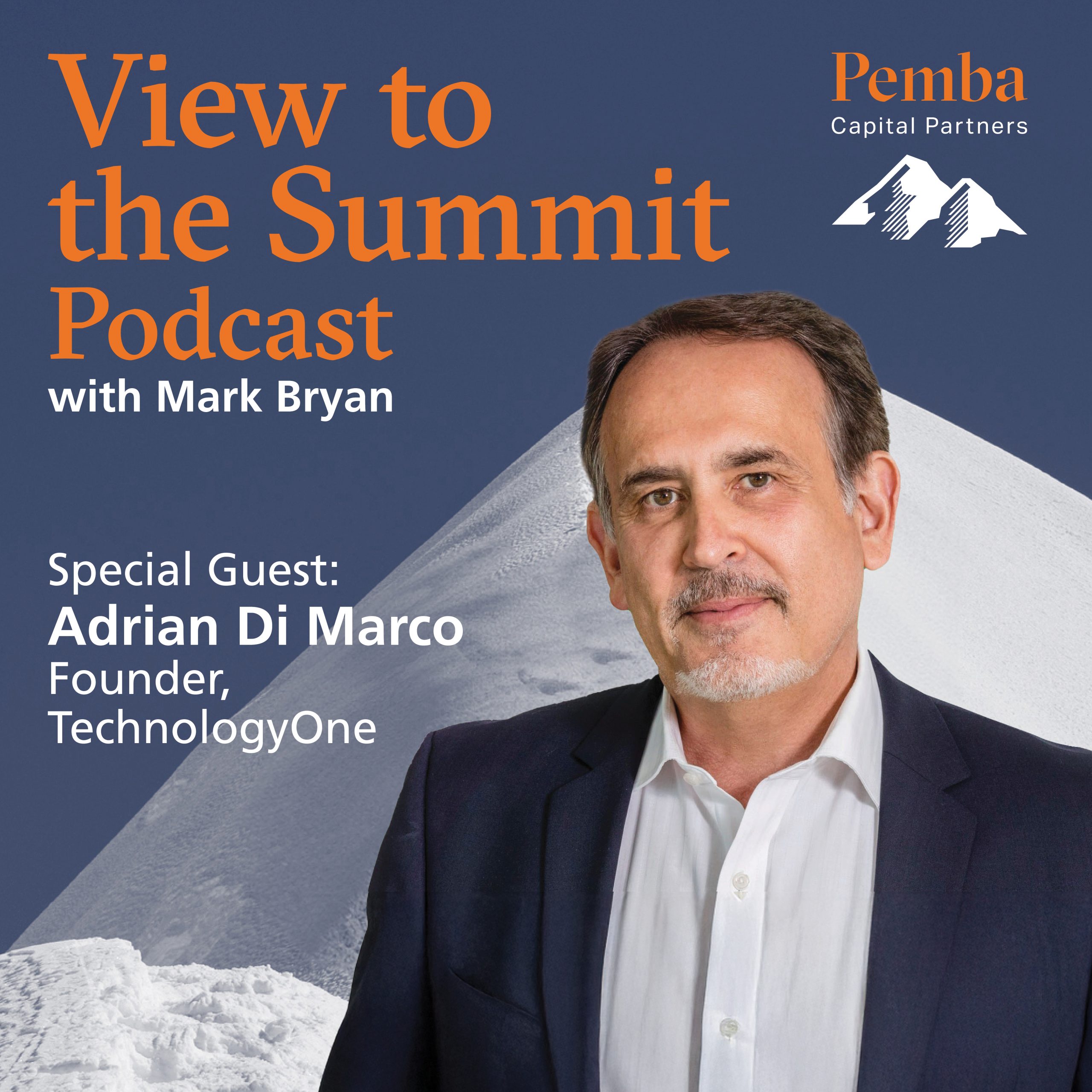
A very warm welcome to View to the Summit, the Pemba podcast for founders and CEOs looking to scale to their next summit. For our returning listeners, thank you for joining us again and for those tuning in for the first time, it’s great to have you on the journey. I’m Mark Bryan, one of the managing directors here at Pemba and today I’m really excited to be joined by Adrian Di Marco, founder and former CEO of TechnologyOne, widely known as TechOne.
Adrian founded TechOne in 1987 in Brisbane, where we’re recording today. He led the business over three decades, building one of Australia’s most successful technology growth stories. Today, TechOne is Australia’s leading enterprise software company, providing integrated SaaS solutions across finance, HR, payroll, asset management and student systems, primarily to government, education and regulated industries from a single, fully integrated cloud solution.
Adrian, it’s great to have you with us. Welcome to View to the Summit. Well, thank you very much, Mark, for inviting me.
Great to have you here. So today we’re going to explore founding vision, scaling a software business in Australia, succession, product reinvention and building a high-performance sales culture. So Adrian, I’ve personally observed the TechnologyOne trajectory over a period of about 15 years and continue to be amazed at the growth rate of the business that now has a market cap of over $9 billion, has team members of over 1,500 and about 1,200 customers.
It’s an incredible growth journey. You must be enormously proud of the achievement. If you go back to when you founded the business in 1987, what were your ambitions and did you ever expect to create such a powerful and well-positioned business?
[Adrian Di Marco] (2:01 – 2:50)
Well, Mark, back then, it was a very different industry to today. Back then, it was sort of dominated by hardware vendors. There wasn’t a lot of software companies.
It was very much a periphery industry, an industry where if someone asked you what you did and you said tech, they’d because it was just not mainstream like it is today. My idea was very simple. It was just to create a general ledger system with powerful financial reporting.
I said to my wife at the time, if I could pay off the mortgage and have a good salary and have a dozen people working for me, I would be ecstatic. That was my dream and people laugh about it now. They point it out to me all the time, but it was never to be the company that it has become.
[Mark Bryan] (2:50 – 3:11)
An amazing achievement as well. If you look at the business where it is today, large-scale SaaS, highly profitable, long-term customer base, was there a point where your thinking evolved from that sort of initial view to really where the business could get to? Was there sort of a signal that drove you to really sort of try and drive the business even further?
[Adrian Di Marco] (3:13 – 5:22)
Look, I was just a young person. I didn’t have a lot of experience. To be frankly honest, you make it up as you go and you make lots of mistakes.
As you make the mistakes, you pivot and you become better and better if you’re reading the signs. The idea I had initially to where we ended up is totally different. I would have no idea how to get to where we got to.
It’s not like I could look around and say, well, there are other companies that were doing it. We were pioneers in what became enterprise SaaS. We were early pioneers of that and there was not a lot of success here in Australia.
Initially, we were just going to build this GL and financial report writing system. Then our customers said, look, we need more than that. We need an accounting system.
We built an accounting system. Then they came back and they said, well, SAP’s come to Australia and they’ve got this whole enterprise system. We had to say, well, geez, we have to become an enterprise vendor.
That just all evolved. Even the go-to-market strategy, originally we were going to use implementation partners, which is what SAP and Oracle used because it’s a very simple business model. You just build a product and you give it to someone else to sell, market, and implement.
It simplifies and allows you to scale. Well, that just didn’t work for us. We had to do it differently to compete with them.
There were just lots of signals that we got, even just losing business to Oracle and SAP. Even the markets we attacked, we had to find markets that they were weak in. We couldn’t be like a general ERP system.
We focused really into a very narrow niche, which was primarily local government and higher education with a bit of government around it. We were able to build a very deep, unique value through that process. We were always trying to be different.
As I say to people, whenever we imitated our competitors, we failed because they could do it better than us. Whenever we did it differently, whenever we did what was really something that was actually even true to our values, we succeeded. Don’t be a pale imitation of your competitors.
[Mark Bryan] (5:23 – 5:50)
I love that. Also thinking about the business, I certainly came at the business 15 years ago with a lens from an SAP perspective. One of the clear differentiators, as you suggest, Adrian, is not using integration partners.
That would have been a big decision, I would imagine, at the time because that then obviously puts a lot of resourcing pressure on the business. That was clearly a very deliberate part, but a very, very clear part that’s driven success for the business.
[Adrian Di Marco] (5:52 – 7:36)
Yes, it was. To be honest, all those decisions were big decisions and all those decisions were very painful to implement and very hard to implement. Quite often, you’d say, well, maybe we won’t do it because it’s just too hard.
That’s a good example. It was very difficult because we weren’t a consulting implementation company. We had to build all that expertise.
We weren’t a sales and marketing company. We had to build all that expertise. I was just a young guy as well.
I didn’t have a lot of money either. There were lots of obstacles, but having done that, suddenly we had this direct connection to the customers, unlike SAP and Oracle, which have implementation partners. They don’t have that direct connection.
We have that direct connection. When we sign a contract, we take the responsibility for the whole solution. We are the one throat to choke.
Compare that to SAP and Oracle. They have an implementation partner. When there’s a problem, the implementation partner will say, well, you picked the product.
We’re just implementing it, so pay more money. Our attitude was, no, you’ve signed the contract with us. If the product doesn’t do what you expected it to do, we will fix it and we’ll fix it at no charge, but we retain the IP.
Our product became exponentially better and better because we were retaining the IP, putting it into the core product, where SAP and Oracle, they were charging their customers or the implementation partners were, and they were modifying the code at the coalface and was never getting back into the product. I’ll give you an example, too. If a customer rang and they were unhappy, we would put people from R&D into the customer site.
They would go and they’d see in the real world how the software was being used, and they would come back with a whole different understanding. That’s a huge value prop for the customer.
[Mark Bryan] (7:36 – 8:15)
A massive increase in value prop for the customer, as you suggest, and also a really smart way of you delivering IP into your business by creating those exclusive partnerships with the customers. Again, lots of reasons why the business has built for the future and the growth has been very, very consistent. The execution really led to the business delivering compound growth of around 15%.
That was always your mantra. Interested how you managed to achieve this and also avoided the temptation, because I dare say in some years you could well have exceeded that growth rate, but you stayed in a very balanced, measured way and consistently delivered that track record.
[Adrian Di Marco] (8:16 – 9:13)
Yeah, no, that’s a good question. When we started the business, we were actually doubling in size every 12 months. We did that for about five years.
Then we started to double every 18 months. Then we naturally came down to the point where we felt that the natural growth for the business that we could cope with as we got to a certain size was that 15% growth a year, which is doubling every four to five years. When you’re growing like that, growing fast, and when you want to grow consistently, you really come to this conclusion very quickly that whatever you’re doing today is not going to be good enough in a couple of years’ time.
That was really the fundamental awakening for me, that we had to evolve the business very fast. It had to change, continually change. That was really important to continue to improve the business.
[Mark Bryan] (9:14 – 10:02)
Adrian, as part of that, let’s talk about succession, if we can do. We see a number of businesses where founders leave the business and then the business subsequently struggles. That’s categorically not the case with TechOne.
Obviously, the business is continuing to bloom. I first came across Ed Chung, the current CEO, around about 15 years or so ago. Great guy, clearly very, very capable individual.
I saw him go through the business through finance, through products, across multiple functions within the business. Meeting him back then, it was clear he was exceptional, but it wasn’t, I suppose, clear at that stage whether you had positioned him as CEO. In hindsight, how did you think about that rotation?
Was it a deliberate part of the succession strategy? When did you start thinking that this could be my successor?
[Adrian Di Marco] (10:06 – 11:36)
We listed the business in about 1999. We were one of the first software companies to list in Australia. The driver for that wasn’t capital.
We were very capital efficient. We’ve always been hugely capital efficient, very lean and mean. The driver for it was the fact that I wanted an exit strategy for myself.
I wanted to be able to one day close that chapter of my life and move to another chapter. Listing the business was the first step of that process. To me, I didn’t want to be taken out in the proverbial box.
Some founders want to be there to the end. I didn’t want to do that. You start to then think very differently about the business.
You start focusing on people, process, structure, strategy, culture, getting all those elements working. It was a very conscious decision. It took 23 years.
It was 2022 when I retired from the business. By that time, I had all the pieces in place, including the CEO. He had gone through the business into different roles to prove that he was the right person.
I’m still a major shareholder in the company. For me, I’m participating in that continuing growth and upside. It’s a win-win.
The interesting thing is too, as soon as you start thinking about succession, you start to say, well, I want a company that is not resilient and reliant on me as the individual. You start doing all the right things. You start to bring in talented people, people ideally that are better than you.
You’re not worried about them being better than you because you know that you want them to help you take the business next stage. One day, one of them hopefully can run the business.
[Mark Bryan] (11:37 – 11:48)
Very good. It makes sense. You mentioned the listing in the 1990s.
What was your experience with listing? Did you enjoy that process? What were the pros?
What were the cons for the founders listening? I loved it. You loved it?
I loved it.
[Adrian Di Marco] (11:49 – 13:18)
Look, it’s one of the most powerful things you can do because there are so many dimensions to it. Firstly, as a public company, you’re now very transparent and very accountable to your shareholders. That’s a really good thing if you embrace it.
We were always very open and transparent. We told them guidance. We told them what was working, what wasn’t working.
We had then shareholders come back and challenge us. You challenged me on many occasions. That fed into our thinking of how we became a SaaS company and how we would do the accounting for SaaS and all that.
We wouldn’t have been able to handle that as well as we did if we hadn’t been challenged by our shareholders. Then obviously, it’s a liquidity event, so you can take some money off the table. That’s great for staff because they’ve got options that now have real value.
I found it a really positive process. Don’t get me wrong. I hate proxy advisors.
I think they are a total pox on the whole process. I think they had no value at all. I think institutions should do their own analysis and make their own decisions.
That’s the one thing that I did find very irritating was having to deal with these theoretical proxy advisors that hired founder-led businesses, didn’t like the fact I was executive chairman, were trying to lecture me how to run the business. When we were delivering the results and we didn’t have any train smashes, not like we didn’t deserve to be trusted. It wasn’t that we weren’t open and transparent.
That was the one bit that I hated was the proxy advisors.
[Mark Bryan] (13:19 – 13:53)
I can imagine that. The track record speaks volumes. Adrian, we mentioned a moment ago some of the international comps.
It does feel that TechnologyOne has really benefited almost from competing with some major global players in the SaaS and software arena. I certainly remember way, way back in 2010 when I first met you, you were beginning to comp yourself against players like SAP, Oracle, and then a little bit later Workday as well. How much time internally did you spend thinking about international competitors and how did that shape the strategy?
[Adrian Di Marco] (13:54 – 14:53)
Well, there’s two elements to that question. I think the first thing is that we found it very powerful to position ourselves in our marketing literature and our go-to-market strategy against big international companies like Oracle and SAP and later Workday because we wanted to cast a long shadow. Even the listing of the company helped us to even further cast that long shadow.
That was a really positive benefit. I think if you’re the underdog, that’s a good strategy to do is to put yourself and compare yourself in your literature to those bigger players. But then also too, there’s just a lot of stuff you learn.
You look at what they do really well, like SAP and Oracle and Workday, fabulous marketing companies. We had to lift our marketing game significantly. We had to become just a very, very different company when we came to marketing.
That was great for us. But then we also saw the things they weren’t good at. Every time the customer had a problem, they had to pay more money, all these flaws in how they went to market and that allowed us to become a better company as well.
I even used to sneak into their conferences.
[Mark Bryan] (14:53 – 14:53)
[Adrian Di Marco] (14:53 – 15:03)
Oh yeah, try to sneak into their conferences and see what they were doing and see how they presented themselves and their vision. It was great. You learn a lot from that process.
[Mark Bryan] (15:03 – 15:19)
And did you find yourself wanting to recruit people from their businesses for that learning process or did you determine that your business was so differentiated that you didn’t really want their strategy polluting yours, interested in whether you looked upon them as a labor source or not?
[Adrian Di Marco] (15:20 – 15:48)
In the sales and marketing area, we didn’t have a lot of success in recruiting from SAP and Oracle because they’re big organizations and they have a lot of infrastructure and the people that come from that sort of environment expect that infrastructure. And we ran a much leaner, meaner company. And also too, the way we engage with our customers, the go-to market strategy was very different to them and they struggled with that as well.
So it was not successful for us recruiting from those bigger companies.
[Mark Bryan] (15:48 – 16:13)
And I think one of the other differentiators for the business is that every, and I’ll get the exact timing wrong, you’ll probably correct me, but every four or five years you go through a complete re-architecture of the product. And I think, again, that’s quite different from some of those larger bellwethers that maybe are not quite as nimble. So from an R&D perspective, was that sort of one of the key differentiators as well for you?
[Adrian Di Marco] (16:13 – 16:51)
Definitely. I mean, we would rebuild our product line every 10 years. But we’d make sure we do in such a way that there was a clear migration path from the previous generation product to the next generation.
And we didn’t charge for that. So that’s how we rebuilt the software and really gave it that new lease of life. So for example, going from on-premise to SaaS is a good example of that rebuild process.
And it’s a different way of thinking. It’s a different way of architecting the product. You’ve really got to think it through.
How do you get a customer from the previous product to the new product and do it in almost a frictionless, painless way? And that’s challenging.
[Mark Bryan] (16:52 – 17:16)
And Adrian, if we think about competitive differentiation in a world now in the AI environment where it’s arguably easier to replicate software, is one of your big differentiations the fact that actually you’re focused across multiple sectors? So your government, as we said in the intro, government, education, regulated industries. I would imagine that de-risks the business as opposed to being just one vertical SaaS.
[Adrian Di Marco] (17:18 – 18:12)
Definitely. I mean, being an enterprise system, it’s a very broad system. And it encompasses ultimately 30 years worth of business rules that we have put into the software.
And that’s something that AI can’t get to. It cannot get to those 30 years of business rules. So that gives us a very strong moat.
It doesn’t mean that AI can’t succeed long-term because you get very intelligent people from companies like TechOne and SAP and Oracle, and they use AI tools to build a new generation enterprise system. They can do that probably in a third of the time to what it took us to build. But they’ve got to then go through that process of getting all those rules that took us the best part of 30 years to get right, and then all the integration points as well.
[Mark Bryan] (18:12 – 19:00)
Yeah, very much so. And it feels like they always say that history doesn’t repeat, but it rhymes. And it does feel that this current state of the market that we’re in at the moment is actually quite reminiscent to the internet stage and the internet bubble in the sense that for a period in the run-up to the bubble, pretty much every company gets a significant valuation increase.
You then have this period of real volatility where the market’s not quite sure whom are going to be the winners and losers. And then the third phase is where you get a separation of the winners and the losers. And maybe we’re now starting to move towards that phase where winners and losers get separated.
What do you think are going to be the key components just to augment the winners? And are you looking at the moment as to seeing quite good opportunities in the market?
[Adrian Di Marco] (19:01 – 20:19)
Yeah, I’m not sure that the winners will become obvious for still another couple of years. I think we’re still going through that process. But I do think that if you are a product that is not very broad, not very deep, it’s relatively shallow, then I think AI will have a good chance of displacing you.
And the new products that will come out will be that more intuitive, that more easy to use, and it’ll be a lot more cost effective because they’re built with AI. But I think the big enterprise systems are the ones that are going to be the stronger modes and going to be around for a long time. And those products are incorporating AI as well.
So they’re adding all those AI features to become totally autonomous and to have a much more intuitive user interface using natural language and stuff. So I think they will be able to reinforce that mode as well. But I think it will take a little while before the market realizes who the real winners and the losers are.
The market’s always a little bit slow with that, and they always typically get it wrong. If you look back at the dotcom boom, all the companies that they picked didn’t survive. I mean, TechOne was not picked, and we came out of it one of the strongest companies.
So I think the market doesn’t always get it right in the short term.
[Mark Bryan] (20:19 – 20:41)
Yeah. So thinking now around the next phase of your career, since stepping back from the CEO role, you’ve had the opportunity to work closely with a number of founders, both formally and informally. It’s a slightly different vantage point.
And you’ve deliberately not wanted to step onto the boards because of the governance aspect. You just want to sort of get to the nuts and bolts of the business.
[Adrian Di Marco] (20:41 – 21:28)
Well, a couple of reasons. I mean, firstly, I’m a big believer of scaling. Whatever I do, I want to be able to scale.
And if I’m on boards, then that’s not very scalable. So that’s the first problem. The second thing I see is there are a lot of people that are good at governance and can sit on boards.
So I’m not going to add anything unique. And then the third bit is, I think being on a board, your voice gets lost, to be frankly honest, where if you have the founder’s ear and you can talk to him outside of board meetings, then you have a better chance of getting your message across and him understanding the message. So it’s a much more powerful approach, I think.
It’d be different if I was taking a more private equity approach where we were taking a 70% position in a company. Then we want to be on the board. But we are taking a 10% to 20% position in the business.
And we like that. That’s the venture capital model.
[Mark Bryan] (21:29 – 21:49)
Yeah. Yeah. Adrian, digging into that phrase you just used there, scaling up and scaling yourself, you obviously manage.
We talked earlier about succession. And I ask this question with a big slice of humility, given I’ve never founded a business. But what advice do you have for founders that are struggling to get themselves out of the day-to-day and out of the weeds of the business?
[Adrian Di Marco] (21:51 – 23:37)
Look, I think the solution for me was to be very proactive in what I did. And so the business had to change. I mentioned that earlier.
And what I did was, I would restructure the business progressively over a four-year cycle. So I’d start maybe with R&D. And then after I restructured R&D, I would restructure sales and marketing, and then consulting, and then admin, and so on.
So it was a continual process of restructuring progressively each division. And by doing that, I was able to focus on that division, get in, work with the guys, pull it apart, look at where it needed to be in the next three or four years, and take really big risks and do huge changes, significant changes, because I wasn’t endangering the rest of the business. And then once that was restructured and it was performing, the engine was working and the metrics showed that I could just leave it be.
I didn’t need to be involved again. And then I’d then focus on the next division. So it might be R&D.
And so then I would then get involved with R&D. I’d get in the weeds and I’d work with the guys to restructure it and get it right for the next stage. And that’s where the founders, I think, can be very powerful.
If they can get in and work with the guys and lead from the front and particularly give life to their vision, because they know what their vision is. But then once you’ve done it, leave it behind and let it run and put people in place that can run that. And you don’t need to worry about it.
It’s just on remote control. That’s what you want to get to. So it really is about, it’s an old concept of working in the business and then working on the business.
I really believe that’s a very powerful way to do it. I see some founders that never get their hands dirty and other founders that are always in the weed. And I you’ve got to be able to go high, low and then back up.
[Mark Bryan] (23:38 – 24:05)
Adrian, let’s talk about sales culture and pipeline discipline if we can. One of the standout features of Tech 1 has been the consistency of the sales growth over a long period of time. And if I think about Pemba and how we partner with partner companies, it’s often the case that we have to go through quite a significant upgrade in the go-to market.
And that’s something that Technology 1 was very strong at. So I’m keen to understand how you built the sales culture and what was behind the level of consistency in the growth.
[Adrian Di Marco] (24:06 – 25:18)
Yeah, no, that’s a great question. And I think if I look at most companies, sales and marketing is their weak spot. Right.
And I’m really a big believer that you don’t have to have the best product, but you’ve got to have the sales and marketing right. And if you’ve got the sales and marketing right, then you will end up with the best product. And you’ve got to approach sales and marketing as a real discipline, as a real science.
How you build a pipeline, how you value the pipeline, how you harvest the pipeline, how you put the artifacts in to get the deals across the line in a timely fashion. So there’s a whole science that you’ve got to apply to that whole sales marketing process. And it takes a long time to build that.
And every company is different and unique. So there’s not necessarily one model for everyone. The other part of that equation is it has to be done such a way that the whole of the business is integrated into it.
It’s not standalone. Everything in the business is integrated into it because you learn through the sales and marketing process where you’re strong because you’re winning deals. And that tells you where you’re on track.
And then you also learn where you’re weak, where you’re losing the business, why your business isn’t coming in as quick as it should be or not closing as fast as it should be.
[Mark Bryan] (25:19 – 25:25)
And so expand on that if you can, Adrian, that’s fascinating. How did you get the rest of the business along the journey? How did you structure that?
[Adrian Di Marco] (25:26 – 27:02)
Yeah, look, in the end, it was quite simple. We would have all the deals we were going to close for the quarter and they’d be all listed. It wasn’t probabilities.
These are the deals that are going to be closed. And then once those deals were locked in, we would track them every Monday morning. Those deals that closed, those deals that were lost, those deals that were not going to, that had friction and that we need to get involved in.
And the executive team, we would meet and go through those deals every Monday morning. Now, the data was all collected over the weekend, so we could see all the deals that were still tracking as they’re supposed to be. And then we could see the ones that were green that had closed or the ones that were red that now were in danger.
And so then we would then talk about those deals. We’d bring the salesperson in and we’d find what was happening, what was causing the problem. So the competitor had a new feature, a new function.
They were offering more aggressive pricing and offering more aggressive terms. What were they doing? And through that process, then we were able to discuss that and say, well, what can we do about this?
Do we match that? Do we not match that? Do we change?
Do we pivot? And we would then spend a lot of time. We’d learn a lot about where we’re strong and where we’re weak.
But we would do that every Monday morning. And it didn’t take a long time really, because it was all automated and all the data came in overnight, but we would have that meeting. And then from that meeting, there’d be two or three actions that would then come out of it that we’d have to then go in and do a lot more work about.
So it really set the heartbeat of the system, the company, and it drove changes into R&D, into product roadmaps, into pricing, into contracts, into lots of things, even marketing.
[Mark Bryan] (27:03 – 27:22)
That’s fascinating. So complete exec accountability around the pipeline, and then working hand in hand with the sales team to rectify any issues, to remove the blockages. Really sensible stuff.
I think that would have a significant positive impact on a lot of businesses that we meet in that relation as well.
[Mark Bryan]
Thank you for that Adrian, that’s fantastic. Now Adrian, a question we love to ask all our guests is what are the two or three core values or principles that have guided you as a founder or leader? It could be in your business life but it could equally be in your personal life.
[Adrian Di Marco]
The core values to me really comes down to customers and people to be honest and that’s how you build a great business. Tech 1 wouldn’t be here if it wasn’t for an early customer I had before I started Tech 1. You know when no one else would provide capital for the business, he had such a great experience, he provided that initial capital and so that’s how Tech 1 started and through the whole journey of Tech 1 our customers have been with us through the whole process telling us where we’re doing good and where we’re not doing good and all we had to do was step up to the mark to fix the problem and our customers would say look Tech 1 made a mistake here but then they fixed it and that’s really powerful and so we built that customer philosophy into the real core culture of the business you know.
I remember in the early days if a customer rang you know and I might be in a meeting even a board meeting I would leave and I would take that call and I’d say I don’t know what you’re ringing but I’m here to listen and they could then vent about a problem they had and I would say look I don’t know about this but all I can do is apologize I’m really sorry I had that experience and what I’ll say to you is I will fix it and then that became the whole culture of the business like that just fed down through the whole business which is you take a customer call, you walk out, you listen, you don’t have the facts, you listen to them and you apologize and you commit to fix it and that’s why the customer retention rate of Tech 1 is 99% it’s just unheard of in the enterprise world.
The second value is people. You can’t build a great company without people. People are absolutely key to that and getting you know high performing people and keeping those people and not losing them and just like with customers if we lost a customer I had to be given a detailed briefing on why that customer was lost and I would go and talk to the customer as well same with staff if we lost an a staff member I had to be totally briefed on that and then I would go and try to talk to that staff member to find out what happened. So again you’re setting that culture correct and then you know there’s leadership which is the intersection of customers and people because leadership is how do you make customers happy and how do you get your staff to make that happen so they’re probably the three big value drivers for me.
Customer, staff and leadership.
[Mark Bryan]
Customer, people and leadership yeah love it thank you for that Adrian and finally after building a business over multiple decades are there any habits frameworks or tools that you’ve found particularly valuable it might be even a book or a podcast that you’ve enjoyed listening to recently.
[Adrian Di Marco]
I love biographies okay autobiographies I mean I think they’re just a wonderful source of inspiration you know and whether it’s biographies of recent times you know to do with Musk or Jobs or whatever or biographies in the past of people like Edison and Ford they’re just very inspirational because you see these people that really in many ways are very you know normal people you know they have you know their human traits you know they’re they’re not infallible or whatever but they do something amazing you know it’s it’s it’s wonderful to see their story you know of how they they did it you know and I love the fact that they are so human you know like Henry Ford you know he built this amazing company you know and mass production and all that sort of stuff but a very deeply thought individual and you see that time and time again and I find that very inspirational so I love autobiographies never enough of them.
[Mark Bryan]
It’s amazing how many founders we have on the podcast that also really enjoy reading biographies so Adrian I can’t thank you enough for joining us today it’s been a wonderful look back on both history but growth tell us what are you spending your time on now and tell us about your family office.
[Adrian Di Marco]
Well it’s all about family now really okay to be honest that’s the stage of life that I’ve entered you know so I have grandkids you know which I like spending time with and and then obviously the family office is is the huge focus you know bringing my kids into running what we have and you know learning how to be better investors and using tech you know we use a lot of technology okay to automate streamline everything that we do I’ve been a tech kind of guy and we have a huge outsourcing approach to to the way we run the family office as well.
[Mark Bryan]
Yeah and we really integrated sorry to drop you really integrated AI into your into your investment philosophy.
[Adrian Di Marco]
Yeah AI is a big part of it and just using technology to automate streamline everything else and then we benchmark ourselves against a lot of fund managers and we typically outperform 80% of fund managers and 85% so we’re very very happy with it so we’re building that same discipline that I did tech one into the family office which is you know getting the processes the systems right getting the strategy right it’s the same thing just now done in a different industry but it’s wonderful to work with the kids that’s probably the thing I really love yeah I was working with them and handing over to them you know what what I’ve
[Mark Bryan]
created so it’s phenomenal that’s a phenomenal lifetime achievement and great you’re able to spend so much time with the family it’s difficult for me to really summarize uh this this podcast there’s been so many great pearls of wisdom in there do not imitate your competitors be accountable to your customers think about what you’re doing today and how it needs to be in two years time thinking about a culture of change and then those values of course of customer people and leadership so Adrian congratulations again on all your success through your career it’s great to see TechnologyOne prospering so well best of luck with the family office thanks again for joining
[Adrian Di Marco]
us on the podcast thanks Mark really appreciate the opportunity to come in and to have a talk to
[Mark Bryan]
you no not at all thank you so to our listeners thank you for tuning in to view to the summit if you enjoyed today’s conversation please follow the podcast and share it with someone who would find it useful until next time keep striving for your next summit